August 12, 2026: Why This Could Be One of the Best Skywatching Days of the Year

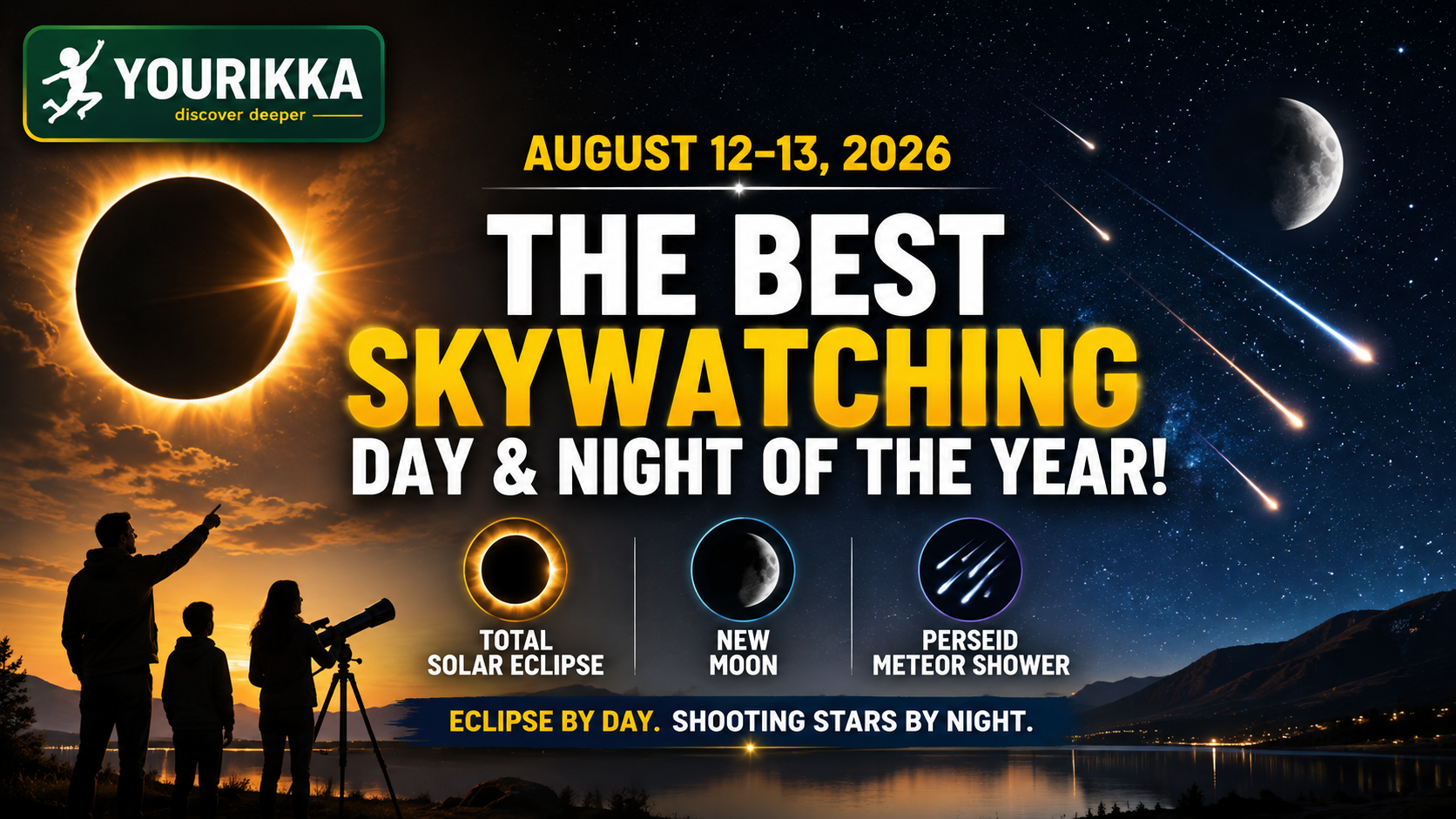
August 12, 2026, could be an unusually exciting day and night for skywatchers. A total solar eclipse will cross parts of the Northern Hemisphere, while the Perseid meteor shower reaches its peak around the same time. With the Moon near its new phase, dark skies will also provide favorable conditions for observing faint stars and meteors.
The eclipse itself will be visible in totality along a path crossing Greenland, Iceland, Spain and parts of Russia, with a partial eclipse visible across a much wider region. NASA is also using the event as an opportunity for scientific observations of the Sun’s corona and Earth’s atmosphere.
Then, as darkness arrives, the sky offers another spectacle: the Perseid meteor shower, one of the year’s best-known meteor showers, reaches its peak overnight from August 12 into August 13. The absence of bright moonlight makes this year’s display particularly interesting for observers under dark skies.
🟢 YOURIKKA SNAPSHOT
🌍 Topic: Astronomy & Skywatching
🚀 Organization: NASA / Global Astronomy Community
🛰 Mission / Study: August 12, 2026 Total Solar Eclipse & Perseid Meteor Shower
📅 Published: August 11, 2026
⭐ Why It Matters: A rare combination of a total solar eclipse, a near-new Moon and the Perseid meteor shower peak makes August 12–13 an especially interesting period for skywatchers.
NASA confirms the eclipse date and visibility, while NASA’s skywatching guidance identifies the Perseid peak on August 12–13.
What’s Happening?
August 12, 2026, is set to bring two major skywatching events together: a total solar eclipse during the day and the peak of the Perseid meteor shower overnight.
The total solar eclipse will occur as the Moon passes directly between Earth and the Sun, temporarily blocking the Sun for observers inside the narrow path of totality. NASA lists northern Russia, Greenland, Iceland, northern Spain and parts of Portugal among the regions that will experience the eclipse, while a partial eclipse will be visible across a much wider area.
The timing is especially interesting because August 12 also brings the New Moon. That means there will be little or no bright moonlight competing with the night sky when the Perseid meteor shower reaches its peak from August 12 into August 13.
The Perseids are created by tiny particles left behind by Comet 109P/Swift-Tuttle. As Earth travels through this debris stream, the particles enter our atmosphere at high speed and heat up, producing the bright streaks commonly called shooting stars.
Explained Simply
What Is a Total Solar Eclipse?
A total solar eclipse happens when the Moon moves directly between Earth and the Sun and completely covers the Sun’s bright disk for observers inside the narrow path of totality. During totality, the sky can become noticeably darker and the Sun’s outer atmosphere, called the corona, becomes visible.
What Are the Perseid Meteors?
The Perseids are one of the most popular annual meteor showers. They occur when Earth passes through tiny pieces of debris left behind by Comet 109P/Swift-Tuttle. As these particles enter Earth’s atmosphere at very high speeds, they heat up and produce the bright streaks of light we call meteors.
Why Is the New Moon Important for Stargazers?
A New Moon is important for meteor watching because the Moon is much less likely to brighten the night sky. With less moonlight washing out faint objects, observers can have darker skies and a better chance of spotting meteors and other celestial sights. NASA notes that the August 12–13, 2026 Perseid peak occurs under dark-sky conditions because of the New Moon
Why This Matters?
The importance of August 12–13 is not just that several skywatching events happen close together. The combination creates an unusual opportunity to experience two very different astronomical phenomena within the same 24-hour period — a total solar eclipse during the day and a major meteor shower peak after dark.
The eclipse also gives scientists an opportunity to study the Sun’s outer atmosphere, known as the corona, while the Moon blocks the bright solar disk. Observations of the corona can help researchers better understand the Sun and its influence on the space environment around Earth.
For skywatchers, the New Moon adds another advantage: darker nighttime skies. That makes faint Perseid meteors easier to notice, provided local weather and viewing conditions are favorable. NASA lists August 12 as the date of the total solar eclipse and August 12–13 as the Perseid peak under dark skies.
Key Highlights
- ☀️ Total Solar Eclipse: A total solar eclipse occurs on August 12, 2026, across parts of northern Russia, Greenland, Iceland, northern Spain, and a small part of Portugal.
- 🌑 New Moon: August 12 is also New Moon, helping keep the night sky darker for meteor watching.
- ☄️ Perseid Peak: The Perseid meteor shower reaches its peak around August 12–13
- 🌌 Dark-Sky Advantage: Less moonlight means faint Perseid meteors should be easier to spot under suitable local conditions.
- 🔭 Science Opportunity: A total solar eclipse gives scientists an opportunity to study the Sun’s outer atmosphere, including the corona.
Did You Know?
🌑 A New Moon won’t make the sky completely dark by itself — local weather, light pollution and the Moon’s position all affect what you can see.
☄️ The Perseids are debris from Comet 109P/Swift-Tuttle. Earth passes through this stream of particles every year, creating the meteor shower.
☀️ During totality, the Sun’s corona can become visible. The Moon blocks the bright solar disk, allowing the much fainter outer atmosphere of the Sun to be seen.
Frequently Asked Questions
What is a total solar eclipse?
A total solar eclipse happens when the Moon completely covers the Sun’s bright disk for observers within the path of totality.
When will the Perseid meteor shower peak in 2026?
The Perseids are expected to peak from the night of August 12 into the early morning of August 13, 2026.
Why is the New Moon good for watching meteors?
A New Moon produces little or no bright moonlight, giving observers darker skies and better conditions for spotting faint meteors.
Where will the August 12 total solar eclipse be visible?
Totality will cross parts of Greenland, Iceland, northern Russia, Spain and a small part of Portugal. A much wider region will experience a partial eclipse.
Is it safe to look directly at the solar eclipse?
No. During the partial phases, use certified eclipse glasses or a safe solar viewer. Ordinary sunglasses are not safe for viewing the Sun
Sources & References
Primary source: [NASA Science — What’s Up: August 2026 Skywatching Tips; Live Science — Will you be looking up on Aug. 12, the best skywatching day and night of the year?]
Yourikka independently explains and presents the information in its own words for educational purposes. Event dates, astronomical details and viewing information were checked against authoritative sources.