
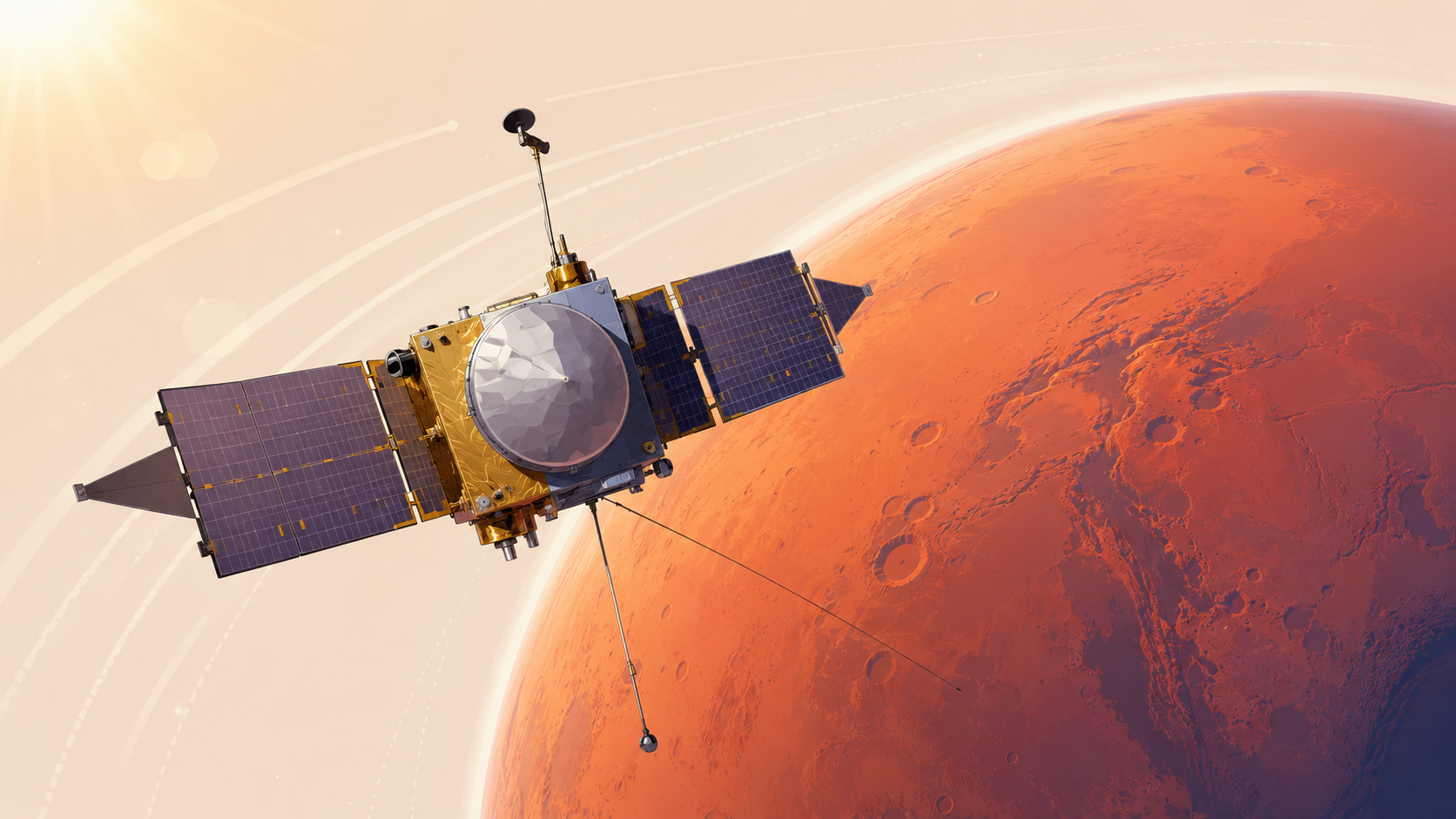
NASA MAVEN Orbiter: Why NASA Said Goodbye to Its Mars Atmosphere Explorer
For over a decade, NASA's MAVEN orbiter sniffed the Martian air, solved the mystery of Mars' lost atmosphere, and relayed data from rovers on the surface. Then, in December 2025, it went silent. Now, NASA has officially declared the mission dead. This is the story of its fatal spin, its greatest discoveries, and why the loss of this beloved spacecraft leaves our Mars infrastructure more fragile than ever.

For over a decade, a silent explorer named MAVEN has been circling Mars, sniffing its thin air and unraveling the mystery of how a once-wet world turned into a freezing desert. Then, six months ago, it went quiet. Now, NASA has officially declared the mission dead. This is the story of its final days, its epic discoveries, and what its loss means for the future of humanity on the Red Planet.
A Funeral for a Spacecraft
Imagine you have a friend who lives 200 million kilometers away. You talk every single day. Then, one morning in December 2025, your calls stop. No goodbye. No static. Just silence.
That is exactly what happened to the team behind NASA’s MAVEN orbiter.
On June 3, 2026, NASA held a sad press conference. “The conclusion is that the spacecraft is not recoverable,” said project manager Mike Moreau. He added, “The team has really experienced the loss of a loved one.”
MAVEN — short for Mars Atmosphere and Volatile Evolution — was more than a machine. It was a pioneer. It was a messenger. And now, it’s a ghost in orbit around the Red Planet.
What Went Wrong? The Strange Spin That Killed a Satellite
A Routine Disappearance Behind Mars
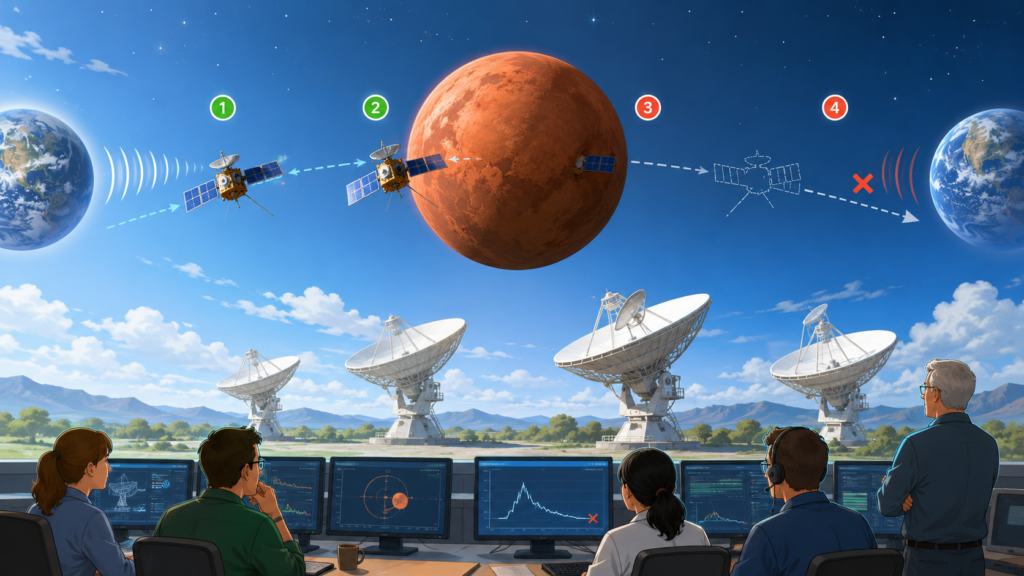
MAVEN last phoned home in December 2025, just as it passed behind Mars — a normal maneuver. But when it was supposed to emerge on the other side, Earth’s radio dishes heard nothing.
A few broken pieces of data arrived on December 6. They revealed something terrifying: MAVEN was spinning like a dizzy top at 2.7 revolutions per minute. It should not have been spinning at all.
A Fatal Battery Drain
According to NASA’s investigation, that unwanted spin drained MAVEN’s batteries completely. Without power, its communication system shut down. The root cause of the spin is still a mystery, but the result is final: one of our best Martian scientists has fallen silent forever.
Did You Know?
MAVEN was spinning almost fast enough to make a human pass out (about 3 rpm causes severe disorientation). But in the vacuum of space, no air resistance exists to slow it down. Once spinning starts, it just keeps going.
Why MAVEN Mattered ? ( And Why we Should Care ? )
You might think, “It’s just an old satellite.” But MAVEN changed everything we know about Mars — and our own future there.
The Great Escape: How Mars Lost Its Air ?
MAVEN’s most important discovery is simple enough for a child to understand: Mars is losing its atmosphere to space, every second, because it has no magnetic shield.
Here’s how it works:
- The Sun shoots out a constant wind of charged particles (the solar wind).
- Earth has a giant magnetic bubble that deflects this wind.
- Mars does not. So the solar wind strips away gas molecules like wind blowing steam off a hot drink.
MAVEN measured this loss: Mars loses about 100 grams of atmosphere every second — roughly the weight of a hamster. During solar storms, that rate jumps ten times higher.
From a Warm, Wet World to a Frozen Wasteland
Billions of years ago, Mars had rivers, lakes, and a thick atmosphere. Today, it’s a cold desert. Why? MAVEN gave us the strongest evidence yet: atmospheric escape.
“The mission provided the strongest evidence yet for why Mars went from a warm, wet world to the cold, dry environment it is today,” says geoscientist Vicky Hamilton.
In other words, MAVEN helped solve one of planetary science’s greatest cold cases: the murder of Mars’ ancient climate.
First Lights on Mars: Auroras and Alien Skies
MAVEN didn’t just study air — it watched Martian auroras. Yes, Mars has lights in its sky too! Unlike Earth’s green curtains, Martian auroras are deep blue and spread across the entire planet.
MAVEN even coordinated with the Perseverance rover to capture the first aurora seen from the surface of Mars. Future astronauts will one day look up and see those shimmering lights — thanks to MAVEN.
The Ripple Effect: How MAVEN’s Death Hurts Mars Exploration Today ?
A Broken Link in the Relay Chain
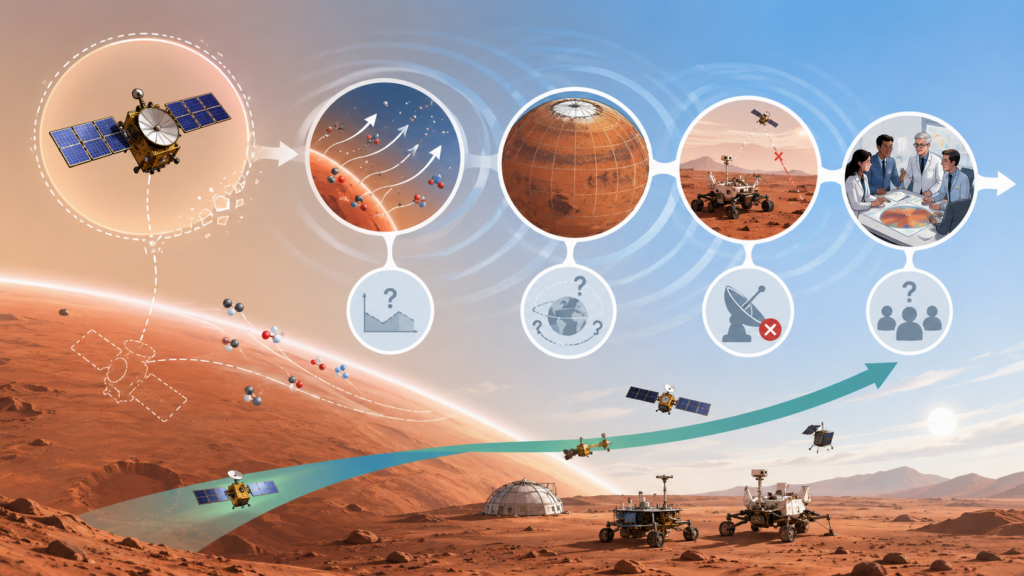
MAVEN was not just a scientist. It was also a mail carrier. It belonged to NASA’s Mars Relay Network — a group of five aging satellites that bounce signals from rovers on the ground back to Earth.
Now that network is down to four. The rovers (like Perseverance and Curiosity) still work, but data now arrives with occasional delays. “MAVEN was critical in getting science data,” said Tiffany Morgan of NASA’s Mars Exploration Program.
An Aging, Fragile Fleet
The remaining satellites are 10 to 25 years old — ancient in space terms. Budget cuts threaten them too. “Our Mars infrastructure is growing increasingly more fragile every year,” warns planetary scientist Briony Horgan.
NASA is planning a new telecom network, but it may not be ready until 2030. That’s a long time to rely on tired, old machines.
Why It Matters – For Science, For Mars, For Us ?
MAVEN’s story is not just about a dead satellite. It is about how we learn to live beyond Earth.
- If we want to send humans to Mars, we need to understand its atmosphere — how it escapes, how it protects (or fails to protect) against radiation.
- If we want to terraform Mars one day, MAVEN’s data tells us how much air we would need to replace every second.
- And if we want to find ancient life, we need to know where the water went. MAVEN helped answer that.
The loss of MAVEN is a reminder: space exploration is fragile, slow, and deeply human. We fall in love with robots. We mourn them. And then we build better ones.
Did You Know? (Fun & Fast Facts)
- Hamster-weight loss: Mars loses about 100g of atmosphere per second — the same as a small pet hamster.
- Solar storm boost: During a big solar flare, Mars loses air 10x faster.
- First of its kind: MAVEN was the first mission to directly measure “sputtering” — where heavy ions knock light molecules out of the atmosphere.
- Spinning mystery: The fatal spin that killed MAVEN is still unexplained. No one knows what hit it or why.
- Auroras on Mars: They are not green like Earth’s — they are blue and cover the whole planet.
Frequently Asked Questions (FAQ)
Q: Is MAVEN completely dead? Can’t we reboot it?
A: No. Its batteries are drained, and it’s spinning uncontrollably. NASA confirmed it is “not recoverable.” It will remain in Mars orbit as a silent relic.Q: How long did MAVEN last?
A: It launched in November 2013, arrived at Mars in September 2014, and died in December 2025. That’s over 11 years — far beyond its planned 2-year mission.Q: Will MAVEN crash into Mars?
A: Possibly, but not for many years. Its orbit is stable for now. Eventually, atmospheric drag will slow it down, and it will burn up like a meteor.Q: Does this affect the Perseverance rover?
A: Only slightly. Data takes longer to arrive now, but the rover is fine. The bigger worry is if another old relay satellite dies.Q: Could humans have prevented this?
A: Probably not. The spinning was unexpected. But future orbiters will have better backup systems and self-stopping thrusters.
Source Credit
This article is based on reporting by Science News (June 5, 2026) and original statements from NASA’s June 3, 2026 press conference. Key contributors include:
- Mike Moreau (NASA Goddard) – project manager
- Shannon Curry (University of Colorado Boulder) – MAVEN principal investigator
- Vicky Hamilton (Southwest Research Institute)
- Tiffany Morgan (NASA Mars Exploration Program)
- Briony Horgan (Purdue University)
📖 Original source: Science News – “NASA declares MAVEN, its Mars atmosphere orbiter, dead”
This article is part of a beginner-friendly space exploration series. For more stories like this, subscribe to our free newsletter — and never miss the death or birth of a world-changer.
