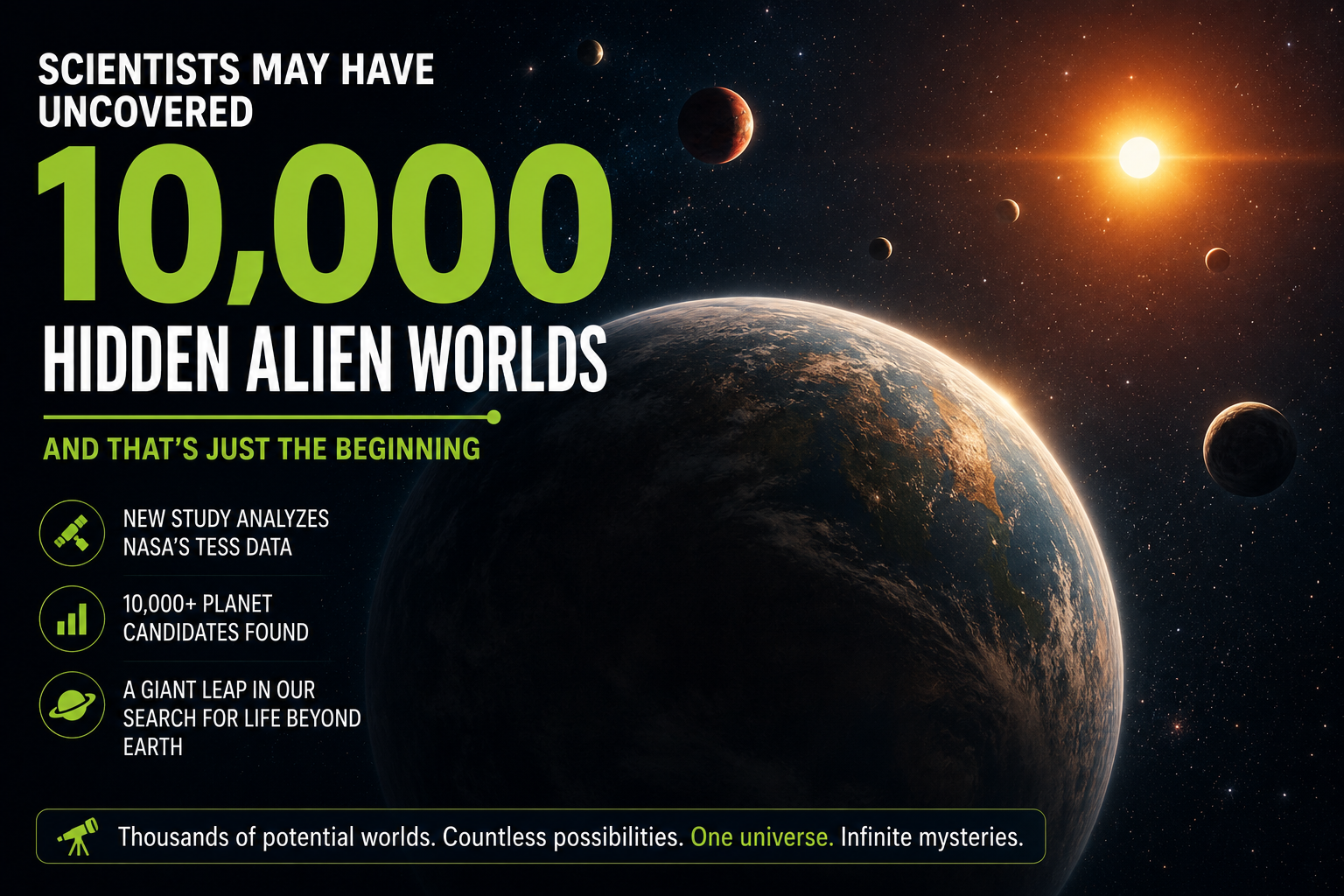
Scientists May Have Uncovered 10,000 Hidden Alien Worlds Using AI and NASA TESS
Scientists may have uncovered more than 10,000 hidden alien worlds by analyzing data from NASA's TESS mission with advanced artificial intelligence. Discover how researchers found these mysterious exoplanets and why the discovery could transform the search for life beyond Earth.

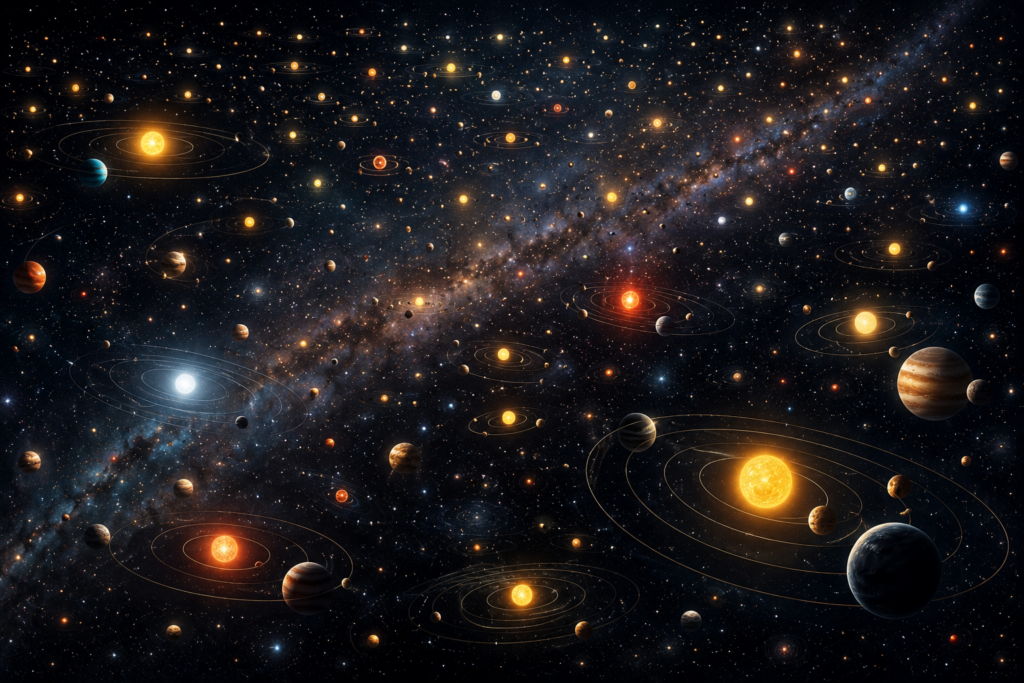
Imagine looking up at the night sky and realizing that every bright point of light could have its own family of planets.
Some may be barren worlds scorched by their stars. Others could be frozen wastelands drifting through darkness. A few might even resemble Earth, with oceans, clouds, and conditions suitable for life.
For centuries, such ideas belonged mostly to science fiction.
Today, they are a major focus of modern astronomy.
And now, researchers have announced a discovery that could dramatically expand humanity’s map of the universe: more than 10,000 potential exoplanet candidates hidden within data collected by NASA’s planet-hunting mission.
If many of these candidates are eventually confirmed, the number of known worlds beyond our solar system could increase dramatically, giving astronomers one of the largest collections of alien planets ever assembled.
The discovery is exciting not only because of the enormous number involved, but also because of how these potential worlds were found. Instead of building a new telescope or launching another spacecraft, scientists turned to a powerful combination of artificial intelligence, machine learning, and existing astronomical data.
The result suggests that thousands of undiscovered planets may have been hiding in plain sight all along.
Why Astronomers Are So Excited
Numbers alone do not always tell the whole story.
However, in this case, the figure is difficult to ignore.
For decades, astronomers have carefully built a catalog of exoplanets—worlds that orbit stars beyond our Sun. Each discovery has helped researchers understand how planetary systems form, evolve, and differ from our own solar system.
The process has been slow and challenging.
Planets are tiny compared to stars. They are dim, difficult to observe directly, and often hidden by the overwhelming brightness of their host stars.
Because of this, discovering even a single new planet can require extensive analysis and verification.
Finding thousands at once is another matter entirely.
That is why the possibility of more than 10,000 new candidates has captured the attention of the scientific community.
If confirmed, these worlds could provide valuable clues about the structure of our galaxy, the diversity of planetary systems, and the likelihood that Earth-like environments exist elsewhere in the cosmos.
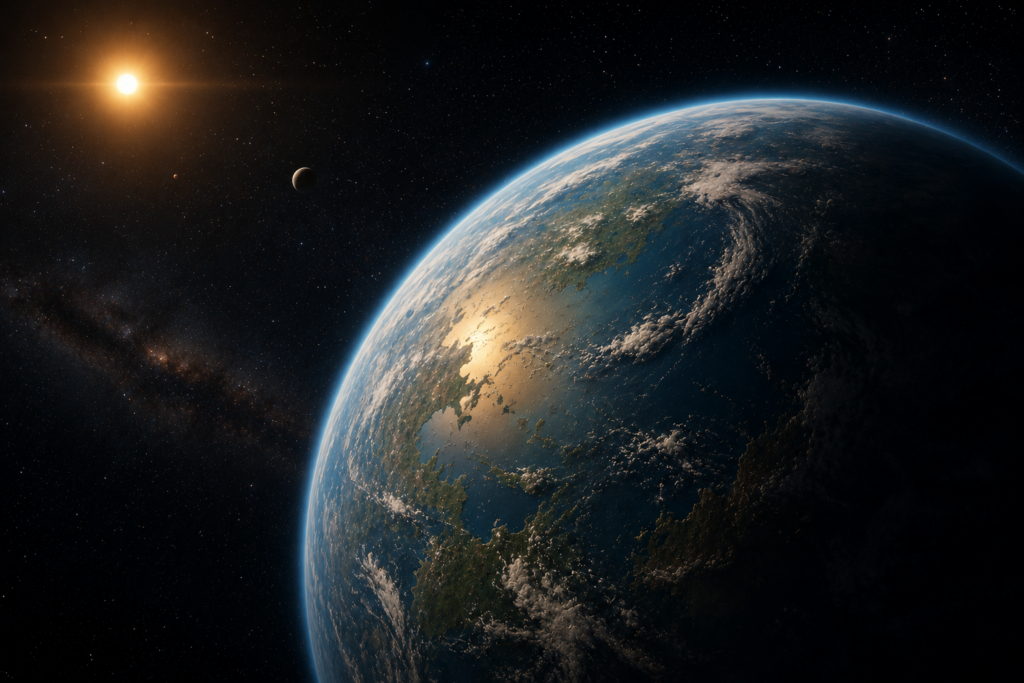
The Search for Worlds Beyond Our Solar System
Not long ago, humanity knew of only one planetary system: our own.
Mercury, Venus, Earth, Mars, Jupiter, Saturn, Uranus, and Neptune were the only known planets orbiting a star.
Astronomers suspected that other stars might host planets as well, but proving it was extraordinarily difficult.
Everything changed in 1995.
That year, scientists confirmed the existence of a planet orbiting a Sun-like star outside our solar system. The discovery transformed astronomy and launched one of the most exciting scientific searches in modern history.
Since then, thousands of exoplanets have been identified.
Some are giant gas worlds many times larger than Jupiter.
Some orbit so close to their stars that a year lasts only a few days.
Others appear to be rocky planets that may resemble Earth.
Every new discovery reveals something unexpected about the universe.
Instead of finding planetary systems that look like our own, astronomers discovered an astonishing variety of worlds that challenged existing theories about how planets form and evolve.
The more scientists searched, the stranger the universe appeared.
Meet TESS: NASA’s Planet Hunter
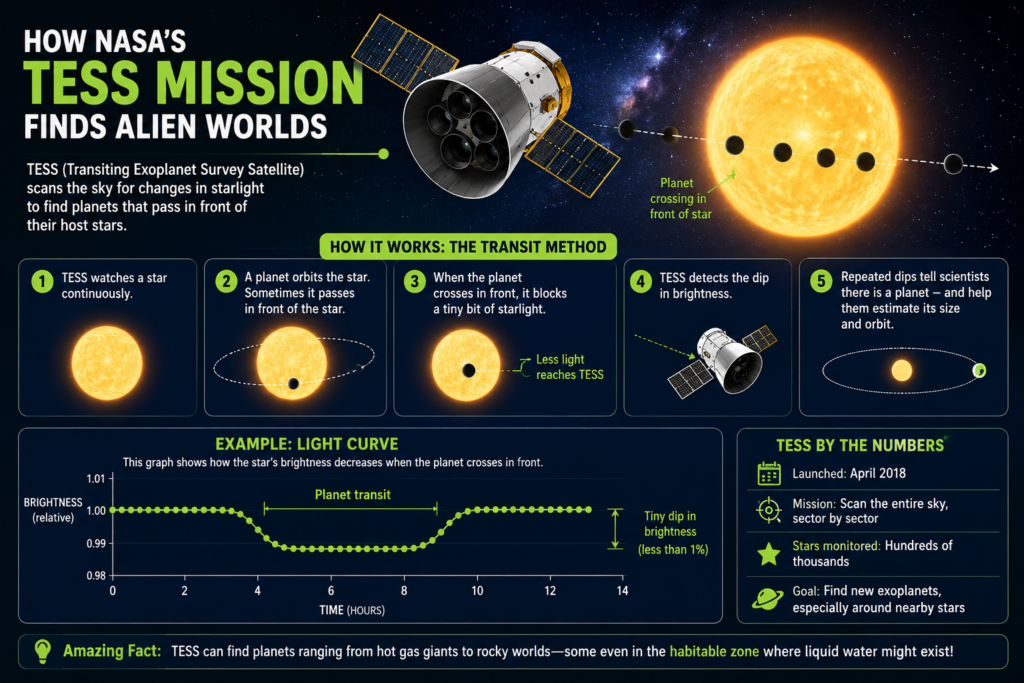
One of the most important tools in this search is NASA’s Transiting Exoplanet Survey Satellite, better known as TESS.
Launched in 2018, TESS was designed to scan large portions of the sky and search for planets orbiting nearby stars.
Unlike traditional telescopes that focus on producing detailed images, TESS concentrates on measuring changes in starlight.
Its mission is simple in concept but incredibly powerful in practice.
The spacecraft continuously monitors the brightness of hundreds of thousands of stars.
Whenever a planet passes in front of a star from Earth’s perspective, it blocks a tiny fraction of the star’s light.
This brief decrease in brightness is known as a transit.
TESS records these subtle dips and sends the information back to Earth for analysis.
By studying the timing and repetition of these signals, astronomers can identify potential planets and estimate some of their characteristics.
The approach has proven remarkably successful.
Since its launch, TESS has helped identify thousands of planetary candidates and significantly expanded humanity’s knowledge of nearby planetary systems.
But TESS also creates a challenge.
The spacecraft collects an enormous amount of information.
Far more than human researchers can easily examine on their own.
This is where artificial intelligence enters the story.
A Universe Hidden in Data
Modern astronomy has entered the age of big data.
Every night, observatories and space telescopes generate vast amounts of information. Hidden within that data are signals that may represent planets, stars, galaxies, black holes, and countless other cosmic phenomena.
The difficulty is separating genuine discoveries from noise.
A tiny dip in starlight might indicate a planet.
It might also be caused by stellar activity, instrumental effects, or other astronomical events.
Distinguishing between these possibilities requires careful analysis.
Researchers involved in the new study used advanced machine-learning techniques to examine an enormous collection of TESS observations.
Instead of manually reviewing every signal, the system was trained to recognize patterns commonly associated with planetary transits.
The results surprised even experienced astronomers.
Among the millions of observations, the algorithm identified more than 10,000 potential new planet candidates that had not previously been cataloged.
The discovery suggests that existing astronomical archives may contain many more hidden worlds waiting to be uncovered.
Why Some Researchers Called These Worlds “Impossible”
The word “impossible” has appeared in many headlines about this discovery.
But do these planets actually defy the laws of physics?
Not at all.
The term refers to how difficult these candidates were expected to be to find.
Many of the signals were hidden within enormous datasets collected by TESS. Some orbit faint stars that are traditionally harder to study, while others produce extremely subtle transit signals that can easily be overlooked.
For years, astronomers suspected that additional planets might be hiding within existing observations. The challenge was finding them.
Machine-learning systems gave researchers a new way to search.
Instead of examining one signal at a time, algorithms could rapidly analyze huge amounts of data and identify patterns that would take humans months or even years to uncover.
In that sense, these planets were not impossible.
They were simply hidden.
Are These Worlds Real?
This is perhaps the most important question.
At the moment, these objects are considered planet candidates rather than confirmed planets.
A candidate is a signal that appears promising but still requires additional investigation.
Astronomers must rule out other explanations before declaring a discovery official.
For example, a dip in starlight could be caused by:
- A binary star system
- Stellar activity
- Instrumental noise
- Background astronomical objects
Scientists therefore use additional observations and analysis to verify whether a signal truly represents a planet.
This process can take months or even years.
Some candidates will eventually be confirmed.
Others may be removed from the list after further study.
That is normal in exoplanet research.
Even so, identifying more than 10,000 promising candidates represents an extraordinary achievement and provides astronomers with a huge number of potential targets for future investigation.
Could Any of These Worlds Host Life?
Whenever a major exoplanet discovery is announced, one question quickly follows:
Could life exist there?
The honest answer is that nobody knows yet.
Scientists still need to determine the size, composition, atmosphere, and temperature of many of these candidates.
Some may be giant gas planets similar to Jupiter, making them unlikely homes for life as we know it.
Others could orbit extremely close to their stars and experience temperatures hot enough to melt metal.
However, among thousands of candidates, there is always the possibility that some worlds may possess more favorable conditions.
Researchers are particularly interested in planets that orbit within a star’s habitable zone — the region where temperatures may allow liquid water to exist on a planet’s surface.
Water is considered one of the key ingredients for life.
Finding potentially habitable worlds remains one of the most important goals in modern astronomy.
Exoplanets Explained Simply
Imagine our solar system as a single house in a gigantic city.
For centuries, humanity knew only that one house.
Today, astronomers have discovered that the city contains countless other houses, neighborhoods, and entire districts we never knew existed.
Each exoplanet is another world with its own story.
Some have skies unlike anything on Earth.
Some may have multiple suns.
Others may experience extreme weather, giant storms, or conditions beyond human imagination.
The possible discovery of 10,000 additional candidates suggests that the universe may be even more crowded with planets than scientists previously believed.
Rather than being rare exceptions, planetary systems may be one of the most common features of the cosmos.
💡 Did You Know?
Astronomers estimate that the Milky Way galaxy alone may contain hundreds of billions of planets.
Even if only a tiny fraction are Earth-like, the number of potentially interesting worlds could still be enormous.
🤔 Think About It
Every exoplanet discovered so far exists within just a tiny region of the observable universe.
If scientists are finding thousands of worlds around nearby stars, how many planets might exist across the billions of galaxies scattered throughout the cosmos?
The true number could be almost impossible to imagine.
Questions Readers Often Ask
What exactly is an exoplanet?
An exoplanet is a planet that orbits a star outside our solar system.
How many exoplanets have scientists confirmed?
Astronomers have confirmed more than 6,000 exoplanets, with new discoveries being announced regularly.
What is NASA’s TESS mission?
TESS is a space telescope launched in 2018 to search for planets around nearby stars by monitoring changes in their brightness.
Are all 10,000 candidates definitely planets?
No. They are currently considered candidates and require additional observations before they can be officially confirmed.
Could humans ever visit an exoplanet?
With today’s technology, exoplanets are far too distant for human travel. Future advances may one day make such journeys possible, but they remain far beyond our current capabilities.
Final Thoughts
The possible discovery of more than 10,000 new exoplanet candidates is not merely a story about numbers.
It is a reminder that the universe still contains countless mysteries waiting to be uncovered.
By combining powerful telescopes with artificial intelligence, scientists are revealing worlds that remained hidden for years within existing data.
Many of these candidates may eventually prove to be real planets. Some could become important targets for future missions. A few may even help answer one of humanity’s oldest questions:
Are we alone in the universe?
For now, the search continues.
And with every new discovery, the cosmos becomes a little larger, a little stranger, and a lot more fascinating.
Sources and Further Reading
This article is based on recent scientific reporting about machine-learning-assisted exoplanet searches using data from NASA’s Transiting Exoplanet Survey Satellite (TESS), along with publicly available astronomical research and mission information. Readers interested in the technical details are encouraged to consult the original research publications and official mission resources.