80 Years After Trinity: Scientists Discover a Strange Crystal Born in the First Nuclear Blast

In the scorching desert of New Mexico, the world’s first nuclear explosion changed history forever on July 16, 1945. Now, nearly 80 years later, researchers studying the aftermath of that blast have uncovered something unexpected — a rare crystal structure that may never naturally form on Earth.
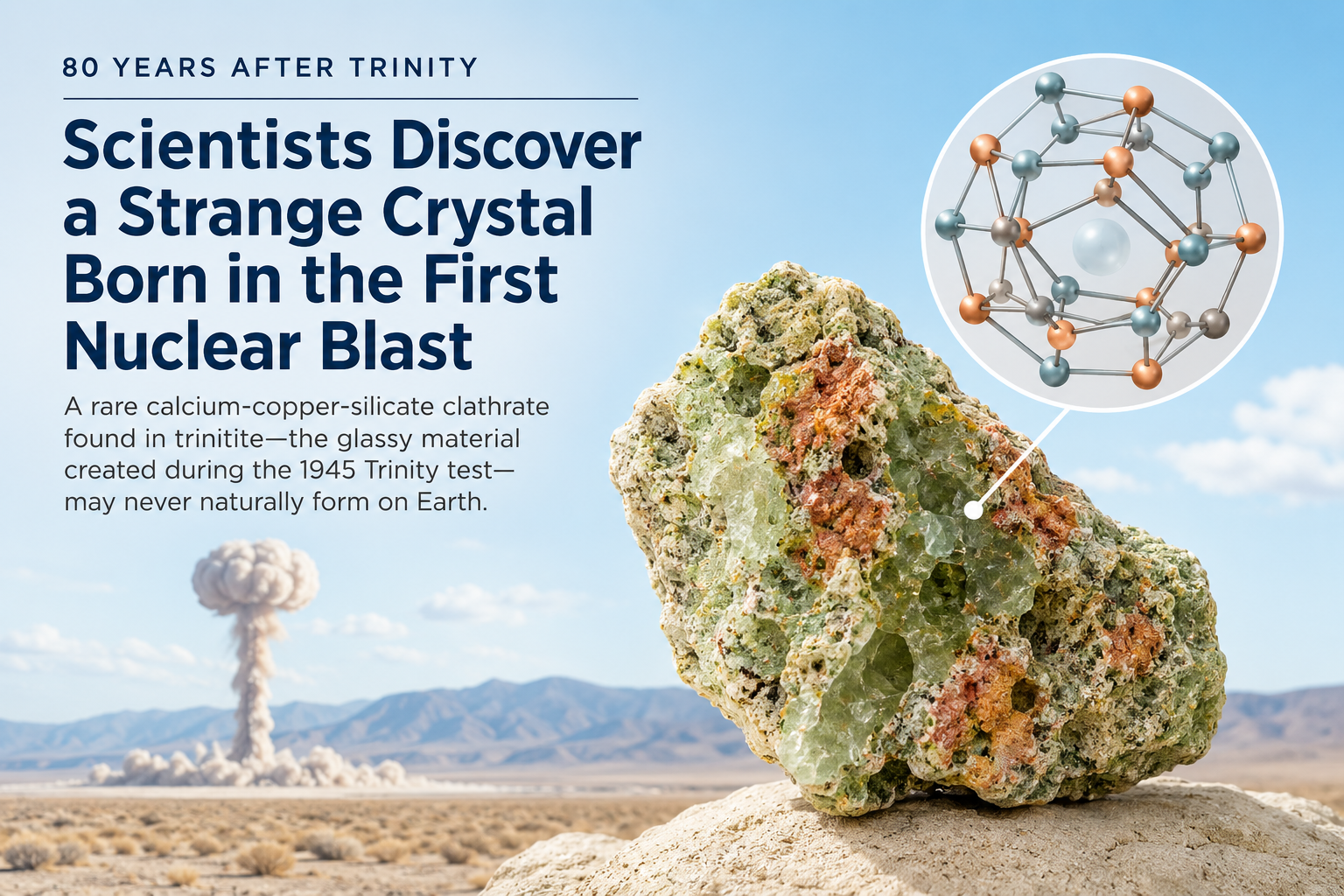
The discovery emerged from an analysis of “trinitite,” the glass-like material created when the Trinity nuclear test melted desert sand, steel, copper wiring, and other surrounding materials under unimaginable heat and pressure. Scientists found the unusual structure hidden inside a reddish variety of trinitite formed close to the explosion site.
Researchers identified the material as a previously unknown calcium-copper-silicate clathrate — a crystal with tiny cage-like atomic structures capable of trapping molecules inside. According to the team, the extreme conditions generated by the atomic blast created an environment unlike anything typically found in nature.
Scientists say the blast briefly produced temperatures hotter than the surface of the sun, instantly vaporizing the steel tower and surrounding equipment. As the molten material cooled rapidly, entirely new mineral structures were frozen into place.
The Trinity test itself was conducted as part of the Manhattan Project and marked humanity’s first detonation of a nuclear weapon. The explosion released energy equivalent to roughly 25 kilotons of TNT and transformed the desert ground into radioactive green glass known as trinitite.
This is not the first strange material discovered at the Trinity site. In 2021, scientists also identified a rare quasicrystal formed during the same explosion — another structure once thought nearly impossible under normal Earth conditions.
Researchers believe studying these exotic materials could help scientists better understand the chemistry of nuclear detonations and improve methods used to detect illicit nuclear tests in the future. The findings also offer a rare scientific snapshot of matter formed during one of the most extreme man-made events in history.
Beyond its scientific importance, the discovery serves as a reminder of how a single moment in history reshaped both geopolitics and science. The Trinity explosion not only ushered in the atomic age — it also created materials that may never have existed otherwise.