
The Cosmic Morse Code Finally Deciphered: How Astronomers Solved One of Space’s Greatest Radio Mysteries

A strange heartbeat from deep space
For years, astronomers around the world were haunted by an eerie mystery.
Out in the Milky Way, something was sending rhythmic radio pulses across space — signals that repeated again and again with clock-like precision. Unlike ordinary cosmic explosions that flash once and disappear forever, these bursts kept returning. Every few hours, the Universe seemed to whisper the same message.
Nobody knew why.
The signals did not behave like normal pulsars. They did not match black holes. They did not fully resemble supernova remnants. And they certainly did not fit neatly into existing models of how stars behave.
Some scientists wondered whether astronomers had discovered an entirely new class of celestial object.
Others believed the strange emissions could rewrite parts of astrophysics itself.
Now, after years of investigation, astronomers may finally have their answer.
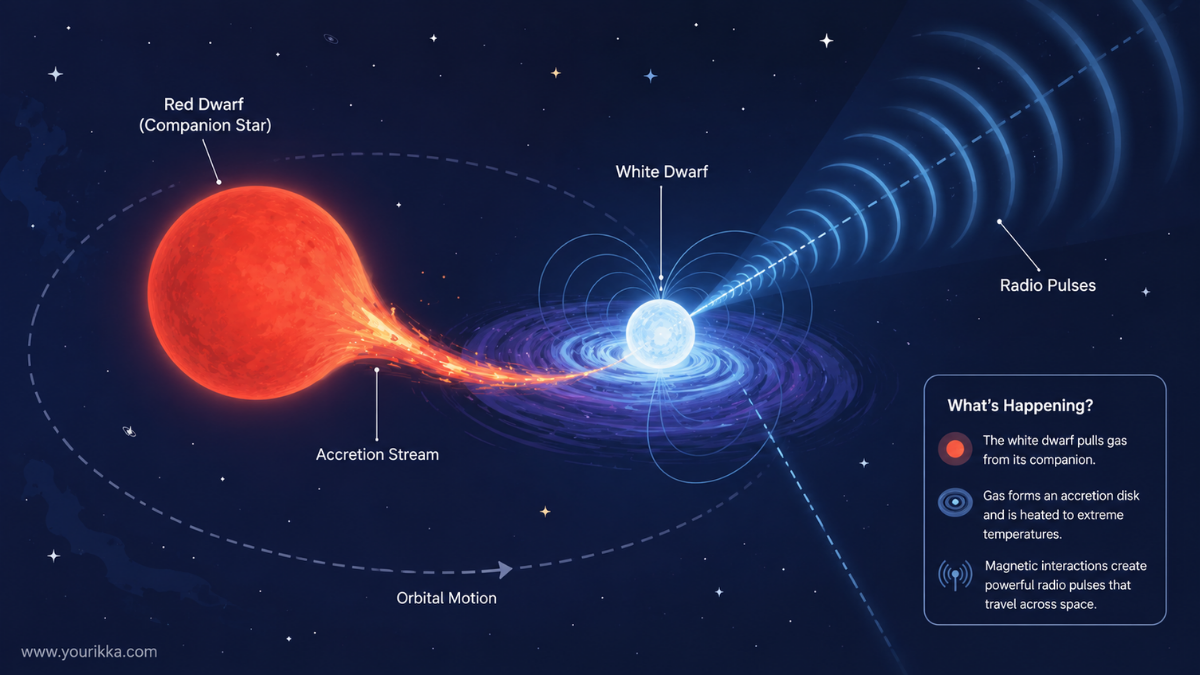
Using some of the world’s most advanced telescopes, researchers identified the likely source of these mysterious repeating signals: a dead star cannibalizing a living companion in a violent cosmic dance.
The discovery is being described as a kind of “stellar Rosetta Stone” — a key that may help decode many other unexplained radio signals scattered across our galaxy.
The mystery of long-period radio transients
To understand why this discovery matters, we first need to understand the mystery itself.
Astronomers call these strange emissions “long-period radio transients.”
That name may sound technical, but it simply means:
- Long-period → the signals repeat slowly
- Radio → they emit radio waves
- Transients → they appear and disappear
This was unusual because most known repeating radio sources in space behave very differently.
Take pulsars, for example.
Pulsars are rapidly spinning neutron stars — incredibly dense stellar remnants left behind after massive stars explode. As they spin, beams of radiation sweep across space like lighthouse beams. If Earth lies in the path of those beams, astronomers detect regular pulses.
But pulsars usually spin very fast.
Some rotate many times every second.
The mysterious long-period transients, however, repeated on timescales measured in tens of minutes or even hours.
That created a major problem.
According to conventional theories, neutron stars spinning that slowly should not produce strong radio bursts at all.
Yet the signals existed.
And they refused to be explained.
A new suspect emerges
Astronomers began searching for alternative explanations.
Could the signals come from binary star systems?
Could magnetic interactions between stars create the bursts?
Could white dwarfs — the compact remnants of smaller stars — somehow mimic pulsar behavior?
These questions became increasingly important as new mysterious signals were discovered.
Although only about a dozen long-period radio transients had been identified, each new detection strengthened the idea that astronomers were witnessing a previously unknown cosmic phenomenon.
Then came a breakthrough.
A team led by researchers from the University of Sydney used Australia’s ASKAP radio telescope to trace one particular signal to its source.
The object was named ASKAP J1745−5051.
And it turned out to be far stranger than scientists expected.
A cosmic vampire system
At the heart of the mystery lies an extraordinary stellar pair.
One member is a white dwarf — the dense core left behind after a Sun-like star dies.
The other is a red dwarf — a smaller, cooler star that is still alive.
These two stars orbit each other at extremely close range.
So close, in fact, that the white dwarf is actively pulling material away from its companion.
Imagine a stellar vampire draining gas from a neighboring star.
That is essentially what is happening.
Astronomers call systems like this “cataclysmic variables.”
As stolen gas spirals toward the white dwarf, it forms an extremely hot stream of material. The gas becomes compressed and heated to enormous temperatures, producing X-rays in the process.
But something even more dramatic is happening.
The magnetic fields of the two stars are colliding and interacting violently.
These magnetic clashes appear to generate powerful radio bursts that sweep through space every 1.4 hours.
For the first time, astronomers had strong evidence connecting long-period radio transients to a specific physical system.
The mystery was finally beginning to crack.
Why this discovery matters
At first glance, this may sound like just another astronomical discovery.
But it could fundamentally reshape our understanding of radio phenomena in the galaxy.
For years, astronomers struggled because long-period radio transients did not fit established categories.
Science depends heavily on classification.
If scientists can classify an object, they can predict its behavior.
But these signals resisted classification.
Now researchers finally have a working model.
At least some of these mysterious radio bursts may come from interacting binary systems involving white dwarfs instead of neutron stars.
That changes the entire conversation.
Instead of inventing exotic new physics, astronomers may simply need to rethink how magnetic interactions operate in compact star systems.
The ASKAP telescope: the instrument that spotted the mystery
This discovery would not have been possible without one of Australia’s most powerful radio observatories.
ASKAP — the Australian Square Kilometre Array Pathfinder — was specifically designed to scan huge portions of the sky quickly and sensitively.
Unlike traditional telescopes that focus narrowly on small regions, ASKAP can observe wide areas simultaneously.
That makes it ideal for detecting rare and unpredictable cosmic events.
Long-period transients are especially difficult to find because:
- They are relatively faint
- They appear intermittently
- They may repeat only after long delays
Many telescopes could easily miss them entirely.
ASKAP’s wide-field capability allowed astronomers to monitor enormous sky regions continuously until the mysterious pulses appeared.
In a sense, ASKAP became a cosmic surveillance system listening for whispers from deep space.
Understanding white dwarfs
To appreciate how unusual this system is, it helps to understand white dwarfs themselves.
White dwarfs are stellar corpses.
When stars like our Sun exhaust their nuclear fuel, they do not explode dramatically like massive stars. Instead, they shed their outer layers and leave behind an extremely dense core.
That core becomes a white dwarf.
Although a white dwarf may contain mass comparable to the Sun, it is compressed into a body roughly the size of Earth.
The result is extraordinary density.
A spoonful of white dwarf matter would weigh tons on Earth.
Normally, white dwarfs are relatively quiet objects.
But when paired with another nearby star, things become dangerous.
Gravity allows the white dwarf to siphon material away from its companion. The stolen gas forms a rotating accretion flow that heats up tremendously.
These systems can become highly energetic laboratories of extreme physics.
Magnetic warfare between stars
One of the most fascinating aspects of this discovery involves magnetism.
Both stars possess magnetic fields.
When these fields interact, they can twist, reconnect, and release tremendous amounts of energy.
Something similar happens on the Sun.
Solar flares occur when magnetic field lines snap and reconnect, releasing energy into space.
But in ASKAP J1745−5051, the interactions are far more intense.
The magnetic environment may accelerate charged particles to enormous speeds, generating focused beams of radio emission.
Interestingly, astronomers noticed that the radio signals and X-ray emissions do not peak at exactly the same time.
That suggests the two forms of radiation originate in different regions of the system.
This provides important clues about the physical mechanisms involved.
Scientists are essentially mapping invisible magnetic battle zones around the stars.
Why astronomers once blamed pulsars
Before this discovery, neutron stars were the leading suspects.
That was understandable.
Pulsars are already known to produce regular radio pulses.
But the timing did not work.
A slowly spinning neutron star should not generate strong radio beams according to current theories.
This contradiction forced scientists into an uncomfortable position.
Either:
- The objects were not neutron stars
or - Existing pulsar physics was incomplete
The new white dwarf explanation offers a compelling alternative.
It does not require rewriting all neutron star theory.
Instead, it introduces another pathway for generating periodic radio bursts.
This is often how science progresses.
A mystery initially appears to challenge fundamental theory, but later discoveries reveal a hidden mechanism nobody had previously considered.
Could there be many more hidden systems?
Probably.
That is one of the most exciting implications of this research.
Astronomers suspect many long-period radio transients remain undiscovered.
The Milky Way contains hundreds of billions of stars.
Even extremely rare systems may still exist in huge numbers.
The challenge is detection.
Radio bursts can be brief, directional, and intermittent.
If telescopes are not looking at the right moment, the signals vanish unnoticed.
Future radio observatories may dramatically expand the catalog of these objects.
Projects such as the Square Kilometre Array (SKA) could uncover thousands of previously hidden radio transients.
If that happens, astronomers may discover that violent white dwarf binaries are far more common than currently believed.
A “Rosetta Stone” for the cosmos
Researchers compared this discovery to the Rosetta Stone for good reason.
The real Rosetta Stone helped scholars decode ancient Egyptian hieroglyphics because it contained the same text written in multiple languages.
Similarly, ASKAP J1745−5051 may help astronomers decode other mysterious cosmic signals.
Now scientists finally possess a system where:
- The stars can be identified
- The accretion process can be observed
- The periodic emissions can be measured
- Radio and X-ray behavior can be compared
This provides a reference framework.
Other unexplained signals can now be tested against this model.
Some may turn out to be white dwarf systems.
Others may still involve neutron stars.
The discovery creates a roadmap for future investigations.
Multi-wavelength astronomy: seeing the Universe in different colors
An important part of this breakthrough involved combining observations from many telescopes.
Different wavelengths reveal different physical processes.
Radio telescopes detect energetic particle interactions and magnetic phenomena.
X-ray observatories reveal extremely hot environments.
Optical telescopes show visible stellar behavior.
By combining all these observations, astronomers reconstructed a more complete picture of the system.
Modern astronomy increasingly depends on this multi-wavelength approach.
The Universe is not fully visible in ordinary light.
In fact, some of the most violent cosmic events are almost invisible to human eyes.
To truly understand the cosmos, scientists must observe it across the entire electromagnetic spectrum.
Natural laboratories of extreme physics
Systems like ASKAP J1745−5051 are scientifically valuable for another reason.
They allow researchers to study physics under conditions impossible to reproduce on Earth.
The magnetic fields are enormous.
The gravity is extreme.
The temperatures reach millions of degrees.
Matter behaves differently under such conditions.
Studying these environments helps scientists test theories involving:
- Plasma physics
- Magnetism
- Radiation
- Particle acceleration
- Stellar evolution
In many ways, the Universe itself functions as a giant experimental laboratory.
Astronomers simply observe the experiments already happening.
Could these systems produce even stranger phenomena?
Possibly.
Some researchers suspect interacting compact binaries may also contribute to other unexplained cosmic signals.
There are still many unresolved mysteries in radio astronomy, including:
- Fast radio bursts
- Magnetar outbursts
- Unusual X-ray flares
- Intermittent radio pulses
Not all mysteries will share the same explanation.
But discoveries like this demonstrate that binary star interactions can generate surprisingly exotic behavior.
The cosmos may be far more inventive than scientists imagined.
The future of radio astronomy
We are entering a golden age of radio astronomy.
New observatories are becoming more sensitive, faster, and better at scanning huge portions of the sky.
Artificial intelligence is also helping astronomers identify unusual patterns hidden in massive datasets.
The next decade may reveal:
- Entirely new categories of stars
- Unknown types of cosmic explosions
- Hidden black hole systems
- Strange transient signals never before observed
The Universe is not static.
It is dynamic, violent, and constantly changing.
And humanity is only beginning to learn how to listen.
What this discovery teaches us about science
Perhaps the most inspiring part of this story is how science solves mysteries.
The strange signals were not immediately understood.
For years, astronomers debated competing theories.
Some ideas failed.
Others survived.
New instruments provided better data.
Gradually, the puzzle pieces aligned.
Science rarely advances through instant answers.
More often, progress comes through persistence, skepticism, collaboration, and improved observation.
This discovery involved researchers from multiple countries and numerous observatories working together across continents.
It is a reminder that modern science is deeply collaborative.
No single telescope or scientist solves cosmic mysteries alone.
A Universe still filled with secrets
Even now, astronomers do not fully understand long-period radio transients.
ASKAP J1745−5051 may explain some of them — perhaps many.
But not necessarily all.
Other mysterious objects may still hide among the stars.
That uncertainty is what makes astronomy so thrilling.
Every solved mystery often uncovers several new ones.
The night sky may appear calm to human eyes, but behind that silence lies a universe crackling with invisible energy, magnetic violence, and strange cosmic rhythms.
Somewhere out there, dead stars are feeding on living companions.
Magnetic storms are hurling radio waves across the galaxy.
And telescopes on Earth are slowly learning how to interpret the messages.
The cosmic Morse code is finally beginning to make sense.
Research Credit
This article was inspired by research conducted by scientists from the University of Sydney and collaborating institutions using the ASKAP radio telescope and other international observatories. The findings were reported in Nature Astronomy and summarized by ScienceDaily on June 2, 2026.
Source
Original research coverage:
ScienceDaily – A stellar “Rosetta stone” reveals the source of mysterious cosmic signals